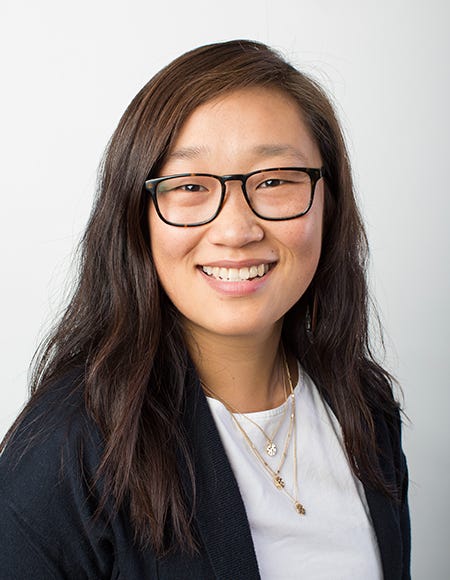
Throwback Community Feature: Michelle Tong, Ph.D. (she/her)
A woman who is shifting narratives — one molecule, one memory, one community at a time.
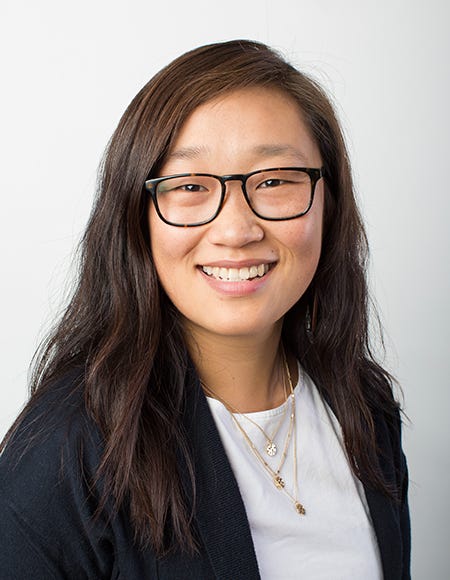
This week’s Community Feature (formerly our #WomanCrushWednesday in STEM or #WCWinSTEM campaign) is Dr. Michelle T. Tong, a powerhouse neuroscientist, inclusive educator, and community builder.
Dr. Tong leads the Tong Research Group at Macalester College, where she investigates how the brain learns and remembers through the study of olfactory memory — the sense of smell. Her work blends curiosity with purpose, guided by a fascination with the senses we often overlook, such as how scent shapes emotion and memory. Beyond the lab, her dedication to mentoring both undergraduates and incarcerated students reflects her belief that science is more than discovery; it is a mirror of who we are and who we choose to include.
Responses may be edited for clarity and brevity. This profile has been updated based on publicly available data.
Where did you go to school?
- Cornell University (Ph.D., Psychology) Thesis: “A spatiotemporal examination of the molecular mechanisms involved in long-term memory for incrementally acquired information”
- Queen’s University (B.Sc., Psychology major; Biology minor) Thesis: “Culture, attention to mood, and the informative value of mood in judgment”
What do you do, and how has life changed since you were last featured?
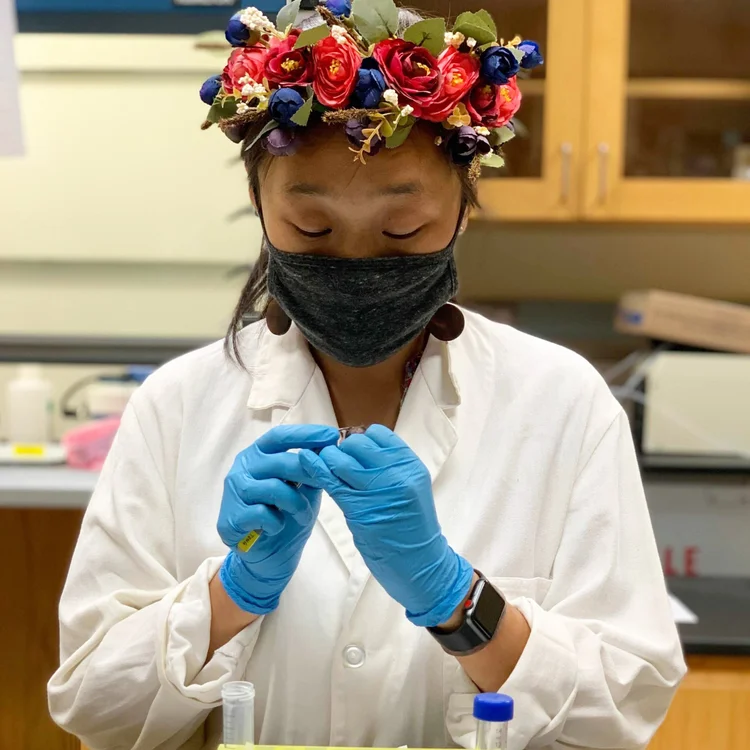
I’m an assistant professor of neuroscience at Macalester College, where I lead the Tong Research Group — a collaborative, undergraduate-centered lab focused on understanding how sensory experiences become long-term memories.
We study how smell-related memories form and last over time — focusing on how positive reinforcement and structures outside brain cells help stabilize and define those memories.
Our work combines behavioral neuroscience, molecular biology, neuropharmacology, and imaging. I also help investigate how male and female adolescents respond differently to benzodiazepines and how specific brain cells in the olfactory bulb function.
Across all of it, I’m committed to creating a lab environment where students are co-investigators — asking bold questions, learning rigorous methods, and seeing themselves as knowledge-makers.
What drew you to your STEM discipline?
I was drawn to olfaction by its mystery. In textbooks, it’s often tucked into a chapter with the other senses, while vision and auditory senses get entire volumes. That imbalance made me curious. I wanted to study what hadn’t yet been fully understood.
What’s one piece of advice you wish you had at the start of your STEM journey?
Make yourself the kind of person who can learn something from anyone.
Even when a class or speaker doesn’t meet your expectations, ask: What’s one insight I can take from this? That mental discipline helps us realize people have more to give than we think.
How does teaching shape your research — and vice versa?
Mentorship is one of the most meaningful parts of my work. I’m deeply committed to creating learning environments where undergraduates feel empowered to ask questions, take intellectual risks, and see themselves as contributors to knowledge — not just consumers of it. In my courses, I use project-based learning and evidence-based teaching strategies, drawing from primary education research and student feedback to continuously refine how I teach.
I’ve also been fortunate to engage with inclusive teaching initiatives through the Center for the Integration of Research, Teaching, and Learning (CIRTL) at Cornell, where I learned strategies for making STEM classrooms more equitable and reflective.
One of the most transformative teaching experiences I’ve had was through the Cornell Prison Education Program. The students I worked with there were, hands down, the most engaged group I’ve had the pleasure to teach. Their curiosity, discipline, and hunger for learning challenged me to be a better educator — and reminded me why access to education matters so deeply.
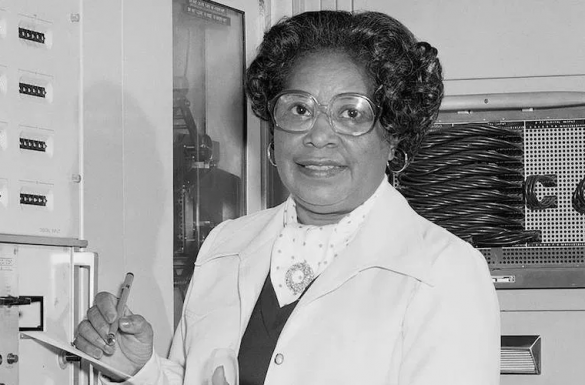
Do you have a woman of color in STEM shero?
Dorothy Vaughan. Her brilliance wasn’t just technical — it was visionary. She saw where her field was headed, learned the skills to stay ahead, and brought others with her. That’s leadership. That’s legacy.
What do you like to do outside of work?
Outside the lab, I enjoy reading books, practicing aikido, spending time with friends, and rotating through various highly specific hobbies — currently: kintsugi, the Japanese art of repairing broken pottery with gold.
Favorite book: The Sellout by Paul Beatty. It’s sharp, satirical, and unflinchingly honest — qualities I admire in both literature and science.
Why is it important to highlight women of color in STEM?
“Women of color often live at the margins of STEM. And from the margins, we see what the center cannot.”
VanguardSTEM is one of the few spaces where I’ve felt STEM being truly self-reflective.
We must amplify voices of women of color — not just because they’re underrepresented, but because they’re modeling the kind of reflection STEM desperately needs.”
You can find Dr. Tong on X (formerly Twitter) : Michelle Tong, PhD (@Professor_Tong) / X.
Thank you, Michelle, for allowing us to share your story! We’re honored to have you in our VanguardSTEM Village!
Copyright © 2017 by The SeRCH Foundation. Consider making a donation to support our work.
Throwback Community Feature: Michelle Tong, PhD was originally published in VanguardSTEM Conversations on Medium, where people are continuing the conversation by highlighting and responding to this story.